
Land & titles
How foreigners can buy property in Uganda, legally
Non-citizens cannot hold mailo or freehold land in Uganda, but they can hold registered leases — which is why condominium apartments are usually the cleanest route. Here is the law and the order of checks.
Yellow Bricks Uganda team · 20 September 2026 · 7 min read
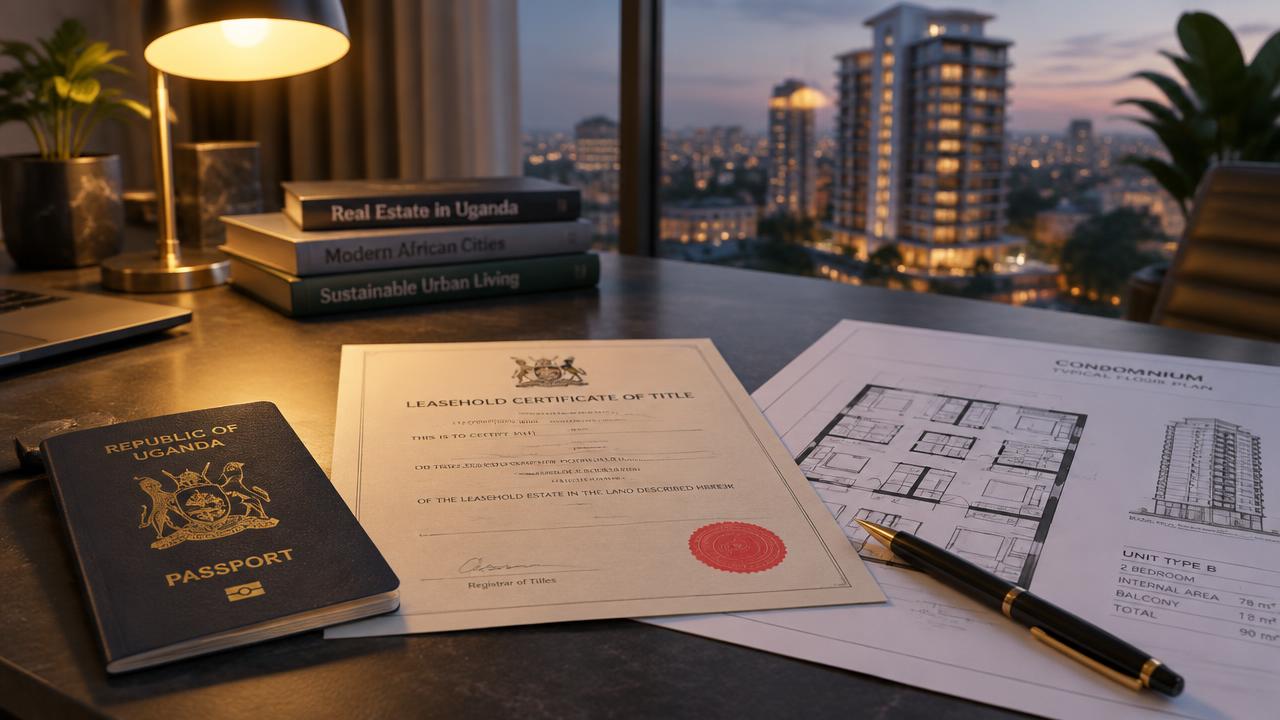
The question foreign buyers ask is 'can I own property in Uganda?'. It is the wrong question, and asking it the wrong way is how people end up with paperwork that cannot be registered. Property can be acquired. What matters is which interest in land a non-citizen may lawfully hold, and how the purchase is structured so that the interest is registrable in your own name.
The rule, in plain terms
Uganda's Constitution vests land in the citizens of Uganda. Non-citizens may acquire leases in land in accordance with the law. The Land Act then puts numbers on that: a non-citizen may acquire a lease, leases of five years or more must be registered, and a lease granted to a non-citizen may not exceed ninety-nine years. So the lawful foreign interest is a registered leasehold — long, secure, transferable, mortgageable, but a lease.
What a non-citizen may not hold is freehold or mailo land. The Land Act goes further: where a Ugandan citizen holding freehold or mailo ceases to be a citizen, that tenure converts automatically into a ninety-nine-year lease from the date citizenship is lost. Dual-citizenship and naturalisation questions therefore matter to your title, not just to your travel documents.
The lawful foreign interest in Ugandan land is a registered lease. Anything presented as freehold ownership by a non-citizen is either misunderstood or misrepresented.
Buying through a company does not get around it
A common piece of advice is to register a Ugandan company and buy through it. The Land Act anticipates that. A body corporate is treated as a non-citizen where a controlling interest is held by non-citizens; where, in a body without shares, decision-making rests with non-citizens; where shares are held in trust for non-citizens; or where a Ugandan company's articles do not restrict the transfer or issue of shares to non-citizens. For companies with shares, a controlling interest means majority shareholding by non-citizens.
A company can still be a sensible vehicle — for joint investors, for succession, for separating a business from a family. It is not a way to convert a leasehold entitlement into freehold ownership, and a structure built with that intention is a structure a court or the registry can unpick.
Why apartments are usually the clearest route
The Condominium Property Act allows a building to be divided into units and common property. Once a condominium plan is registered, the registrar opens a separate register for each unit and issues certificates of title for those units, and a unit proprietor may sell, transfer, lease or charge that unit much as land is dealt with under the Registration of Titles Act. A unit can be held as a leasehold estate where the underlying parcel is itself held under lease.
That combination is what makes an apartment workable for a foreign buyer: a distinct, registrable title in a unit, held as a long leasehold interest, without needing to hold tenure the law reserves for citizens. It is also why 'off-plan apartment, foreign buyer, no condominium plan in sight' is the single riskiest shape a Ugandan transaction can take.
Check one: is the project actually structured as a condominium?
Before finishes, views or payment plans, establish whether the development is legally capable of giving you a unit title. The registrar may not register a condominium plan unless it identifies the parcel, the building, the units, their boundaries, their approximate floor areas and the unit factor for each unit, and unless it is accompanied by certificates including one from a registered surveyor and one from the local authority confirming the proposed division was approved under the building laws.
In practice the plan passes through registered professionals, authorities verify ownership, land use and encumbrances, the responsible housing department checks compliance with condominium law, non-compliant plans go back for correction, and only approved plans are registered and titled. Ask where in that sequence your project sits, and ask for evidence rather than reassurance.
Check two: the title and the seller
- Run an independent search on the title through the land registry — your own advocate applies, pays and collects the search letter, not the seller's.
- Look specifically for caveats, mortgages, court orders and anything held as loan security.
- Where the seller is a company, search the company register to confirm it exists, who its directors are and who may sign.
- Confirm the person signing has authority to sign — a directors' resolution, or a properly made power of attorney.
- Match every name and identification document exactly against the registered proprietor.
Marketing documents are not evidence. A brochure, a reservation form and a WhatsApp photograph of a title tell you nothing about the register.
Check three: is the building lawful and occupiable?
Title is one half. The other is whether the building was erected in conformity with approved plans and the building regulations, which is what an occupation permit evidences. For a completed apartment, ask for the occupation permit and the approved plans before you complete. For an off-plan purchase, require clear evidence that the approvals exist, that the condominium plan is being processed lawfully, and that the sale agreement matches the legal structure of the project. If you will not be in Uganda to watch the process, this is the check that has to be written into your contract rather than trusted.
The documents you should be given before you sign
| Document | Why it matters |
|---|---|
| Proof of ownership or authority to sell | Establishes that the person selling can actually transfer the interest |
| Title particulars for an independent search | Lets your advocate verify the register rather than the photocopy |
| Registered or draft condominium plan | Determines whether a unit title can exist at all |
| Sale agreement | Must describe a leasehold unit interest, not impermissible tenure |
| Proposed rules or by-laws | How the building is governed once you own a unit |
| Proposed management agreement | Who runs the common property, and what the service charge covers |
| Lease of the parcel, where relevant | The lease your unit interest ultimately sits on, and its remaining term |
| Certificate of title for the unit or proposed unit | The interest you are paying for |
| Occupation permit and approved plans | Evidence the building is lawful and can be occupied |
Drawn from the Condominium Property Act and published Ministry and building-review requirements. General information only.
Two protections in the Condominium Property Act are worth knowing before you sign anything. A developer must not sell or agree to sell a unit or proposed unit unless the purchaser has been given the sale agreement, the proposed rules, the proposed management agreement, any lease of the parcel where relevant, and a certificate of title for the unit or proposed unit. And a purchaser may rescind the sale agreement within ten days after execution unless all of those documents were delivered at least ten days before signing.
The Act also requires money paid under a sale agreement to be held in trust or insured against loss, and restricts when it may be released to the developer. Ask, in writing, where your deposit will sit and on what event it is released. A developer who cannot answer that question clearly has told you something important.
Buying without being in the country
You can act through an attorney. A power of attorney made in accordance with the Registration of Titles Act is treated as a power of attorney for condominium purposes, and execution and verification of instruments follow the same Act. That is a formal document, properly executed and verified — not a signed letter or an email authorisation.
Instruct an independent Ugandan advocate, meaning one who is not the developer's lawyer and is not introduced by the seller. Their job is to search the title, review the contract, confirm that what you are buying is a lawful leasehold condominium interest, and see the registration through to a title in your name. Land registration and land administration data are increasingly handled digitally in Uganda, which makes remote verification easier — it does not remove the need for someone on the ground accountable to you.
A sensible order of events
- Establish whether you are buying as an individual non-citizen or through an entity that the Land Act also treats as a non-citizen.
- Confirm the interest on offer is a registrable leasehold, and how many years of the underlying lease remain.
- Confirm the project is, or is properly becoming, a registered condominium.
- Search the title and, where relevant, the company.
- Read the sale agreement, condominium rules and management agreement — before the ten-day clock matters.
- Agree in writing how deposits are held and when they are released.
- Require the occupation permit and approved plans before completion.
- Register, and obtain the certificate of title for your unit.
Where Yellow Bricks Uganda fits: every listing we publish starts with a pin on the map, a drawn and measured boundary, and ownership documents read by a person on our team before it goes live. For a buyer working from Dubai, London or Nairobi, that removes the first layer of guesswork. It does not replace your advocate, your surveyor or your own registry search, and we would think less of you if you let it.
What this means for you
- As a non-citizen you can hold a registered lease of up to ninety-nine years — not freehold or mailo.
- A company controlled by non-citizens is treated as a non-citizen too.
- A condominium unit title is usually the cleanest lawful route for an apartment purchase.
- Get the full document pack at least ten days before you sign, and know your right to rescind.
- Confirm where your deposit is held and on what event it is released.
- Use an independent Ugandan advocate — this article is general information, not legal advice.
Where Yellow Bricks fits
We are a fixed-fee estate agency built for Uganda: every listing starts with a pin on the map, a drawn and measured boundary, and ownership documents reviewed before it goes live. This article is general information, not legal or financial advice — use your own lawyer and surveyor.
Keep reading

How to check a land title in Uganda before you pay anything
A registry search, a deed plan and a walk around the boundary cost very little compared with what they protect. Here is exactly what to check and in what order.
4 September 2026 · 4 min read

Kibanja land explained: what you are really buying
Thousands of Ugandan families live on kibanja land. It can be bought and sold safely, but only if you understand that you are buying an occupancy, not a title.
2 September 2026 · 4 min read

A short history of land ownership in Uganda
Mailo, freehold, leasehold and customary land all exist side by side in Uganda. Here is how that happened, and why it still shapes every sale today.
27 August 2026 · 4 min read