
Buying
How Uganda's property market actually works, and who gets paid
There is no single property market in Uganda — there are several overlapping ones. Here is who is involved at each stage, and where money quietly leaves the table.
Yellow Bricks Uganda team · 29 August 2026 · 4 min read
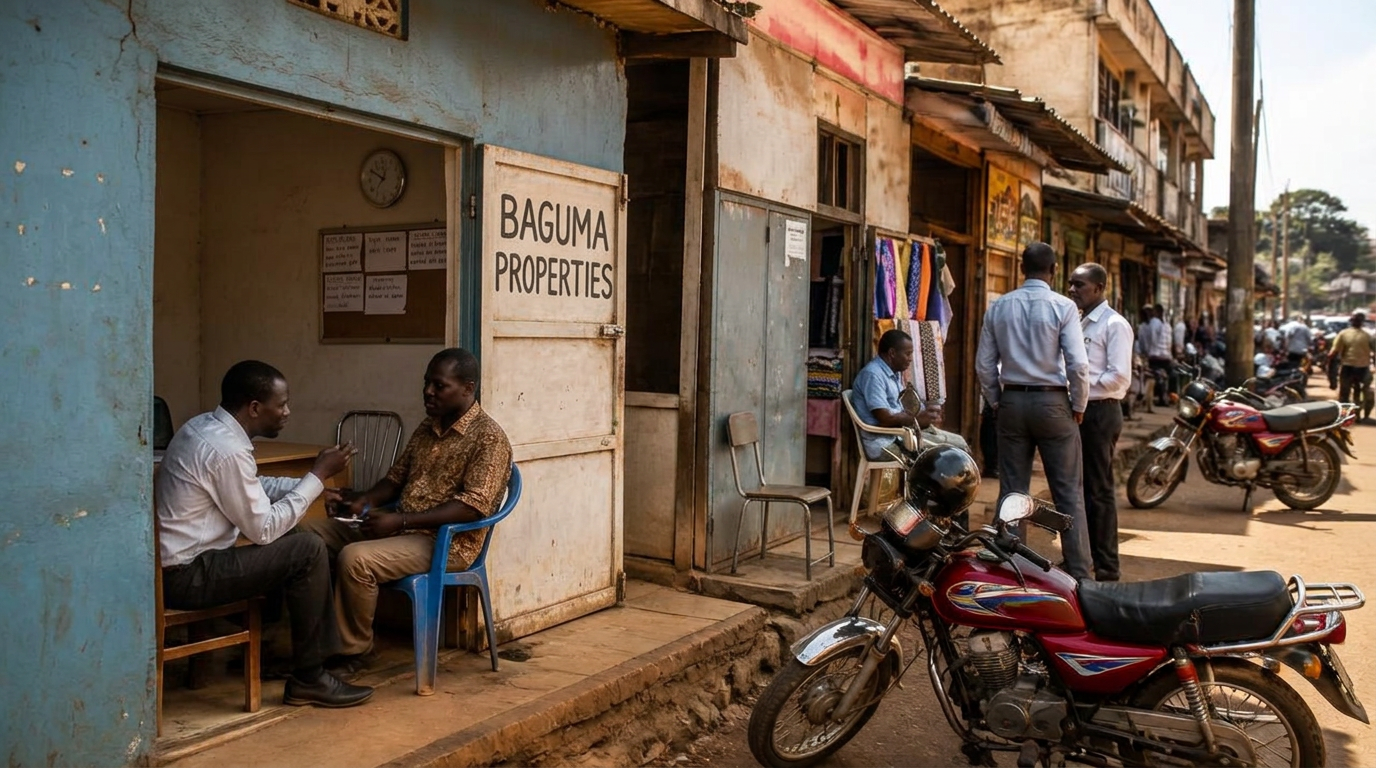
If you have only ever read about property markets in London or Nairobi, Uganda's will confuse you. There is no dominant listings portal that everyone uses, no licensing regime that decides who may call themselves an agent, and no standard commission. What exists instead is a dense, mostly informal network of people who know things — and information is the product being sold.
The four markets in one
- Land and plots: the largest by volume, often sold directly between families, sometimes through a broker who knows the seller.
- Residential homes for sale: fewer transactions, higher values, usually involving a broker or an agency and a lawyer.
- Residential rentals: enormous, fast-moving, and almost entirely informal.
- Commercial space — shops, arcades, offices, warehouses: driven by location and footfall, with its own customs including goodwill payments.
Each of these behaves differently. A formal agency such as an international consultancy might handle a Grade A office letting in Nakasero with a written mandate and a market report; the same city sells thousands of plots a year through a phone call and a handwritten sale agreement.
Who is actually in the chain
The word 'broker' covers a very wide range of people. At one end there are established firms with offices, records and professional staff. At the other, there is someone who heard that a landlord has a vacant unit and is now standing at the gate offering to show it to you. Both are described the same way, and neither is currently required to hold a licence.
That matters because a single transaction can accumulate several intermediaries. A broker who does not know the owner may take you to a broker who does. Each expects a share. Nobody in the chain has an obligation to tell you how many people are in it, and the cost is usually recovered from whoever has the least information — often the buyer or tenant.
In an informal market, the person who knows the least pays the most. Not because anyone is dishonest, but because nothing forces the facts into the open.
Where the money goes
On sales, commission is usually a percentage of the price, and it is negotiated rather than fixed. It is not unusual for it to be shared between two or three intermediaries. On lettings, the common practice is that the broker earns roughly the equivalent of one month's rent, sometimes split, sometimes topped up by a separate fee charged to the tenant for a viewing.
Then there are the costs that are genuinely part of transferring property: stamp duty, registration and transfer fees, a lawyer to prepare and witness documents, a surveyor if a boundary needs confirming, and a search at the land registry. These are legitimate and worth paying. The problem is not their existence — it is that buyers rarely see the whole list before they commit.
What the government does and does not do
The state runs the land registry and the survey function, issues titles, collects duties, and provides the courts and tribunals where disputes end up. Local land boards and area land committees deal with allocation and with customary land questions. The Landlord and Tenant Act of 2022 sets rules for the relationship between landlords and tenants, including on deposits and notice.
What has not yet happened is statutory regulation of estate agents and brokers themselves. A bill to license real estate agents has been discussed for years without becoming law. Until it does, there is no register you can check to see whether the person showing you a property is entitled to do so, and no professional body that can strike them off.
The consequences you will feel as a buyer or tenant
- Duplicate listings: the same house advertised by four people at four prices.
- Stale listings: property that was sold or let months ago and is still being shown to attract enquiries.
- Unclear authority: nobody has confirmed that the person offering the property is instructed by its owner.
- Fees that appear late: a viewing charge, a facilitation fee, a share for a second broker.
- Unverified boundaries: an agreed price on land whose extent nobody has measured.
How to work with it rather than against it
Informality is not the same as dishonesty. Many brokers in Uganda are careful, well-informed people doing real work that a portal cannot replace: they know which landlord is reasonable, which compound floods, which title has a problem. The fix is not to cut them out. It is to make three things explicit at the start of every conversation — who you are dealing with, what they are being paid, and by whom.
Ask early, ask plainly, and write down the answers. A person who is comfortable telling you their fee is usually the person you want to work with.
What this means for you
- Establish who instructed the person you are dealing with, and ask to confirm it with the owner.
- Ask what the total fee is and who pays it, before a viewing, not after an offer.
- Expect and budget for stamp duty, registration, legal fees and a search — get the full list in writing.
- Treat a property still being advertised weeks later as unconfirmed until someone re-checks it.
- Never pay for information alone. Pay for a viewing arranged with the owner's knowledge.
Where Yellow Bricks fits
We are a fixed-fee estate agency built for Uganda: every listing starts with a pin on the map, a drawn and measured boundary, and ownership documents reviewed before it goes live. This article is general information, not legal or financial advice — use your own lawyer and surveyor.
Keep reading

Buying a home in Uganda, step by step
From first viewing to registered transfer: the order the steps should happen in, what each one costs you in time, and the points where buyers most often lose money.
31 August 2026 · 4 min read

How foreigners can buy property in Uganda, legally
Non-citizens cannot hold mailo or freehold land in Uganda, but they can hold registered leases — which is why condominium apartments are usually the cleanest route. Here is the law and the order of checks.
20 September 2026 · 7 min read

Ugandan property as an investment: what diaspora and foreign buyers should model
Rent is collected in shillings, the investor usually thinks in dollars, and the costs people forget are the ones that decide the return. An honest framework for buying from abroad.
20 September 2026 · 5 min read